


Expert in Roswell & Alpharetta
Transmission Diagnosis & Repair
Honest Solutions, No Unnecessary Rebuilds
Alongside your engine block, your vehicle’s transmission is the most complex, sophisticated, and expensive piece of engineering in your car. It is responsible for taking the raw, explosive power generated by your engine and seamlessly transferring it to your wheels, balancing torque and speed in fractions of a second.
When a transmission starts to fail, the feeling of panic is immediate. Many drivers in Roswell & Alpharetta assume that any clunk, slip, or delay in shifting automatically means their transmission is destroyed and they will be facing thousands of dollars in repairs.
Our mission is to eliminate that fear through highly accurate computerized diagnostics and absolute transparency. A hard shift does not always mean you need a completely new transmission. Very often, the solution is as simple as replacing a faulty electronic speed sensor, swapping out a defective shift solenoid, or performing a comprehensive transmission fluid flush. We do not condemn a transmission unless the internal mechanical failure is absolute.
Our goal is to save your existing transmission whenever mechanically possible, keeping your car on the road and protecting your wallet.Request Your Auto Repair Service Today

Need Transmission Repair
The 7 Critical Warning Signs
Modern automatic, CVT, and manual transmissions rarely fail overnight without warning. They consistently send clear physical, auditory, and electronic signals when internal friction, hydraulic pressure drops, or electronic miscommunications occur. If you are commuting down I-75 or navigating Cobb Parkway and experience any of the following, bring your vehicle in immediately
Harsh, Jerky, or "Clunking" Shifts
Do you feel a violent jolt or hear a loud "clunk" when your car shifts from 1st to 2nd gear, or when you move the shifter from Park into Drive or Reverse? This points to worn internal clutch packs, a failing valve body, or even a broken transmission mount that is allowing the entire unit to physically shift under the hood.
Transmission "Slipping" (False Neutral)
This is one of the most dangerous symptoms. You press the gas pedal, the engine RPMs spike loudly, but the car barely accelerates. It feels as if the car temporarily popped into Neutral. This indicates a severe loss of internal hydraulic pressure or completely worn friction bands.
Delayed Engagement
You shift your car into "Drive," but the vehicle sits still for two to three seconds before you feel the gear finally catch. This delay is a classic sign of degraded transmission fluid or a failing internal pump struggling to build enough pressure to engage the gears.
The Check Engine or Transmission Warning Light
Your vehicle’s Transmission Control Module (TCM) constantly monitors speed sensors, fluid temperature, and hydraulic pressure. If a light illuminates on your dashboard, the computer has detected an anomaly. In severe cases, the computer will trigger "Limp Mode," locking the car in 2nd or 3rd gear to prevent you from driving fast and destroying the internal components.
Grinding, Whining, or Humming Noises
In a manual transmission, a grinding noise usually points to worn synchronizer rings or a failing throw-out bearing. In an automatic or CVT, a continuous, high-pitched whine that increases with your vehicle's speed usually indicates a failing torque converter or worn planetary gears.
A Strong Burning Smell
If you step out of your car and smell burning fluid, your transmission is overheating. This happens when the fluid breaks down from age or extreme towing, losing its ability to lubricate. The internal clutches begin to burn against each other, creating extreme friction.
Puddles of Leaking Fluid
Transmission fluid (ATF) is the lifeblood of the system. Unlike engine oil (which is dark brown or black), fresh transmission fluid is bright red and has a slightly sweet, tart smell. If you see a reddish puddle under the center of your car, your transmission is bleeding. Running a transmission low on fluid will cause catastrophic overheating in a matter of miles.

Flushing Process
The "Lifetime Fluid" Myth: Why Transmission Fluid Flushes Are Essential
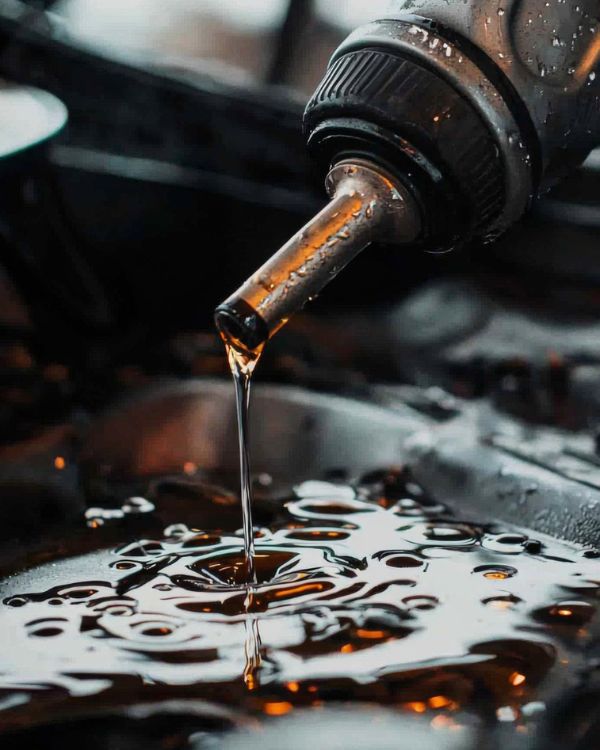
One of the most damaging myths in the automotive industry is the concept of "lifetime transmission fluid." Dealerships often claim you never need to change it. However, the reality of physics dictates otherwise.
Transmission fluid operates under extreme heat and crushing hydraulic pressure. Over tens of thousands of miles, the chemical additives in the fluid break down. Furthermore, as the internal metal gears and clutch plates naturally wear against each other, microscopic metal shavings (metal shavings) break off and circulate through the fluid. Over time, your bright red, protective fluid turns into a dark, abrasive sludge that acts like liquid sandpaper inside your valve body.
Our Advanced Computerized Flushing Process
Unlike a simple "drain and fill" (which only removes about 40% of the old fluid sitting in the bottom pan), we utilize state-of-the-art fluid exchange machines.
- We connect our equipment directly to your transmission’s cooling lines.
- The machine simultaneously pumps 100% of the old, contaminated fluid out while pushing fresh, premium synthetic ATF in.
- We also drop the transmission pan to thoroughly clean the internal magnet (which catches metal shavings) and replace the internal transmission filter.
Our Transparent
Step-by-Step Diagnostic Process
Making The Right Choice
Repair vs. Rebuild vs. Replace
If the worst-case scenario occurs and the internal gears are destroyed, you have options. We will guide you through the most cost-effective route for your specific vehicle
Targeted Repairs
Addressing specific issues without removing the entire transmission from the vehicle (such as replacing a faulty shift solenoid or repairing a leaking pan)provides a targeted solution that restores function while minimizing labor time, overall cost, and unnecessary component replacement.
Transmission Rebuild
We remove the transmission, disassemble it entirely on our workbench, clean the casing, and replace all "soft parts" (clutches, bands, seals, gaskets) and any broken "hard parts" (gears). This is essentially restoring your specific transmission back to factory specifications.
Reman Transmission Replace
We order a fully remanufactured transmission from a top-tier supplier that has been tested on a dynamometer and swap it with your broken unit. This option often comes with an excellent nationwide warranty.