Expert in Roswell & Alpharetta

Brake Repair & Pad Replacemen

Your Safety is Our Top Priority

When you press the brake pedal, you expect your vehicle to stop smoothly, quietly, and immediately. There is no room for compromise when it comes to the safety of your family, your passengers, and other drivers on the road. Your braking system is the single most critical safety component on your vehicle, and ignoring early warning signs of wear can lead to terrifying failures at high speeds.

At our premier auto repair facility in Roswell & Alpharetta, we do not cut corners on brake jobs. We combine highly trained, certified technicians with premium-grade friction materials (pads and rotors) to ensure your vehicle stops exactly as the manufacturer intended. Whether you are dealing with an annoying squeak, a terrifying metallic grind, or a spongy pedal, our team delivers precise diagnostics and honest, transparent brake repair services you can trust.

Request Your Auto Repair Service Today

[contact-form-7 id="" title="Contact Form"]

How Your Braking System Actually Works

To understand why brake maintenance is a recurring necessity, it helps to understand the physics of stopping a heavy, fast-moving machine.

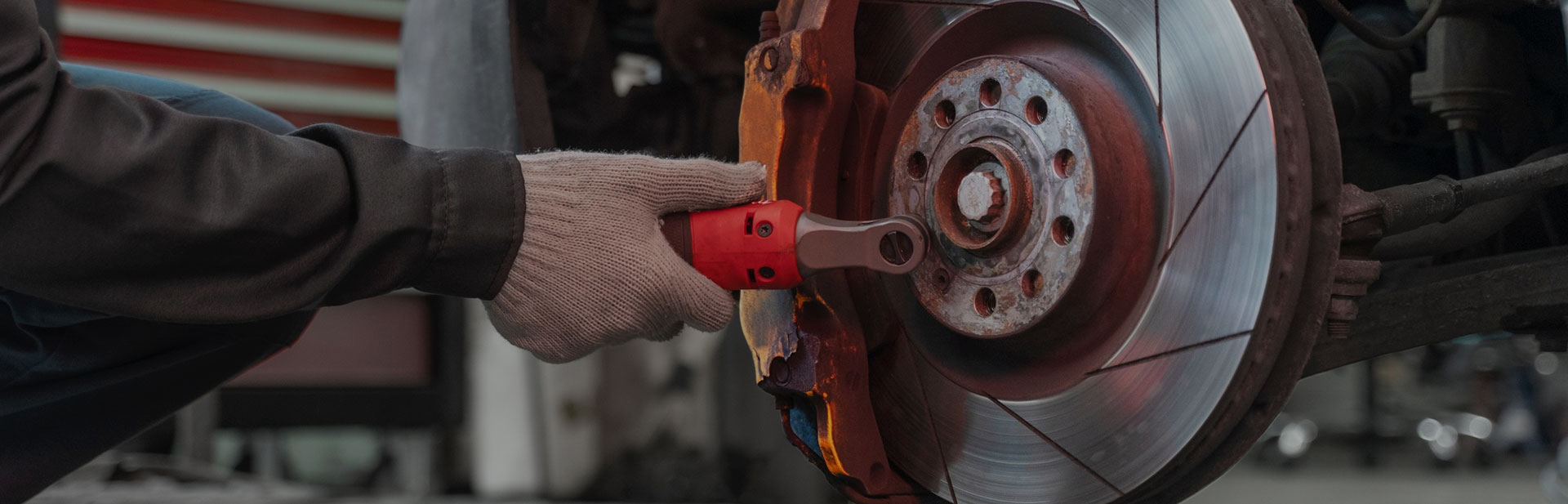
Modern vehicles use a hydraulic disc brake system on the front wheels (and often the rear wheels as well). When you press your foot on the brake pedal, a plunger in the master cylinder pushes hydraulic brake fluid through reinforced steel lines down to the wheels. This high-pressure fluid forces a mechanical clamp (the brake caliper) to squeeze two highly abrasive friction plates (brake pads) against a heavy metal disc (the brake rotor) that spins directly with your wheel.

The intense friction between the brake pads and the spinning metal rotor is what stops the car. However, this friction generates extreme, blistering heat, often exceeding 400 degrees Fahrenheit. Over thousands of miles, this intentional friction slowly physically shaves away the material on your brake pads. This is not a defect; brake pads are explicitly designed to wear out so that your expensive metal rotors (and your car) survive.

Need Immediate Brake Service

The 6 Critical Warning Signs

Brakes do not fail silently. Automotive engineers design braking systems with built-in auditory and physical warning mechanisms to alert you long before a total failure occurs. Do not ignore these six critical signs:

High-Pitched Squealing or Chirping

This is an intentional warning. Modern brake pads have a small metal tab attached to them called a "wear indicator." When the pad material wears down to a dangerously thin level (usually around 2 to 3 millimeters), this metal tab begins to scrape against the metal rotor, producing a loud, high-pitched squeak when you drive. It is your car politely asking for new pads.

Harsh, Violent Metallic Grinding

If the squeaking stops and is replaced by a horrific, deep metal-on-metal grinding noise, you have a severe emergency. The friction material on your brake pad is completely gone, and the bare metal backing plate of the pad is now gouging and destroying your metal brake rotor. Driving in this condition severely compromises your stopping distance and dramatically increases repair costs.

Pulsation or Shaking in the Steering Wheel

If your steering wheel violently shakes or your brake pedal rapidly pulsates up and down when you apply the brakes at highway speeds, your brake rotors are "warped." Extreme heat cycles and rapid cooling (like hitting a deep puddle after heavy braking) can cause the perfectly flat surface of the rotor to become wavy and distorted.

The Car Pulls to One Side When Braking

If your vehicle aggressively darts to the left or right when you hit the brakes, you likely have a "frozen" or sticking brake caliper. One side of the car is applying braking force, while the other side is not, causing a dangerous imbalance in steering control.

The Car Pulls to One Side When Braking

If your vehicle aggressively darts to the left or right when you hit the brakes, you likely have a "frozen" or sticking brake caliper. One side of the car is applying braking force, while the other side is not, causing a dangerous imbalance in steering control.

The ABS or Brake Warning Light is On

If the red "BRAKE" light or the yellow "ABS" (Anti-lock Braking System) light illuminates on your dashboard, your vehicle's computer has detected a serious fault in the hydraulic system or a failing wheel speed sensor.

br_auto_expert_weel_repair

Services

Our Comprehensive Brake Repair

Premium Ceramic & Semi-Metallic Brake Pad Replacement

We do not use cheap, noisy pads that coat your wheels in black dust. We install high-quality Ceramic or advanced Semi-Metallic brake pads engineered to meet or exceed OEM (Original Equipment Manufacturer) specifications. These pads provide superior stopping power, run quieter, dissipate heat faster, and produce drastically less brake dust.

The Rear Main Seal

A brake pad is only as good as the hardware holding it. During every brake job, we thoroughly clean the caliper brackets, lubricate the slide pins with high-temperature silicone grease (ensuring the caliper can move freely), and replace all anti-rattle clips and hardware springs. If a caliper is leaking or frozen, we will replace the entire unit.

Brake Caliper Service & Hardware Replacement

Brake Rotor Resurfacing and Replacement Whenever we replace brake pads, the rotor must be addressed. A perfectly flat, smooth rotor is required for the new pads to bed properly.

Resurfacing (Turning): If your rotors are thick enough and structurally sound, we mount them on a precision brake lathe to shave off a microscopic layer of metal, restoring a perfectly flat, parallel surface.

Replacement: If the rotors are severely warped, heavily rusted, or have worn thinner than the manufacturer's safe minimum thickness limit, we will replace them with high-carbon, thermally stable rotors.

Brake Fluid Exchange
(Flushing)

Brake fluid is "hygroscopic," meaning it naturally absorbs moisture from the air over time. Water in the brake lines drastically lowers the boiling point of the fluid, which can lead to total brake failure under heavy braking (a condition called "brake fade"). It also rusts the expensive internal components of your ABS module. We utilize specialized pressure bleeders to flush out the old, contaminated fluid and replace it with fresh DOT 3, DOT 4, or DOT 5.1 fluid.

FAQs About Brake Repair

How long do brake pads typically last?
The lifespan of a brake pad varies wildly based on your driving habits, the weight of your vehicle, and your daily commute. If you drive aggressively in heavy Marietta stop-and-go traffic, pads may only last 25,000 to 30,000 miles. If you primarily drive on open highways, they can easily last 60,000 miles or more.
Why do my new brakes squeak in the morning?
If you hear a light squeak when backing out of your driveway first thing in the morning, especially after it rains or is highly humid, this is usually normal. A microscopic layer of surface rust forms on the iron rotors overnight. Once you hit the brakes a few times, the pads wipe the rust away and the noise should vanish. If the noise persists all day, bring the car in for an inspection.
Do I need to replace all four brakes at the same time?
Not necessarily. Your front brakes handle about 70% to 80% of your vehicle's total stopping power due to the physics of weight transfer when you slow down. Therefore, front brake pads generally wear out much faster than rear brake pads. We replace brakes in "axle pairs" (both fronts together, or both rears together).
How much does a brake job cost?
The cost depends on the make and model of your vehicle and the extent of the wear. A simple front brake pad replacement is relatively inexpensive. However, if the rotors are destroyed or the calipers need replacing, the cost increases. We always provide a fully transparent, written estimate before performing any work.

Never compromise on your stopping power

If you are experiencing any brake-related issues, call our Marietta shop today to schedule a comprehensive, priority brake inspection.